
产品发布/更新NEW
昨天
Nace AI released Drex Max, a multimodal decision model that reads text and screenshots and returns calibrated probabilities. Nace reports 67.59 on Decision Index 0.3.2 at $0.06 per…
共 436 条相关资讯 · 来自历史归档
Nace AI released Drex Max, a multimodal decision model that reads text and screenshots and returns calibrated probabilities. Nace reports 67.59 on Decision Index 0.3.2 at $0.06 per…
Multimodal large language models (MLLMs) have made rapid progress on visual reasoning, yet many tasks require evidence that is difficult to obtain through internal reasoning alone: our controlled stud…
Multimodal reinforcement learning with verifiable rewards (RLVR) provides reliable task-level supervision, yet offers limited guidance for localizing errors in visual reasoning. On-policy self-distill…
We set out to reproduce a recent hallucination-mitigation result on the POPE benchmark. The LLaVA-1.5-7B baseline we measured, 82.21 F1 on the adversarial split, sat 1.21 to 8.67 points above the adve…
Robotic manipulation is not merely observation-to-action generation, but the realization of task-specified state changes in the physical world. Existing vision-language-action (VLA) methods directly l…
Procedural generation plays a key role in synthetic data creation and game development, offering greater controllability, editability, and diversity than static mesh representations. However, VLM-base…
Voxel51 3.0 merges search, curation, annotation and evaluation of multimodal sensor data into one platform for physical AI teams. It adds Voxel51 Agent with 45+ MCP tools, dataset…
Kyutai, with Inria and École des Ponts, has released REKI, a 2.4B vision-language-action model (VLA) for robot manipulation. The REKI vision-language-action model is pretrained onl…
AI 点评 · 2.4B参数把高效记忆塞进VLA,机器人操控或迎轻量化拐点。
优必选 Thinker-WM在三大公认具身世界模型基准评测中全部拿下第一名
Liquid AI released d1-ultra, a text and image decision model that returns calibrated probabilities in 1 forward pass. It scores 65 on the Artificial Analysis Decision Index and cos…

IT之家 10 月 16 日消息,当地时间 10 月 15 日,Meta 发布了开放权重 AI 模型 Muse Spark Open。Meta 官方宣称, Muse Spark Open 是迄今为止能力最强的美国开放权重模型 。 Muse Spark Open 采用原生多模态架构,总参数量达 816B(其中激活参数 42B),支持 1M token 的上下文…
AI 点评 · 开源阵营再迎重量级选手,多模态加超长上下文或重塑竞争格局。
Multimodal large language models (MLLMs) answer questions about whole images well, yet they still struggle with fine-grained region understanding. A key reason is that text-only supervision never spec…
Safety in Multimodal Large Language Models (MLLMs) depends on unsafe multimodal data for post-training alignment or activation steering. However, such data is hard to collect, must be gathered anew fo…

NVIDIA released Nemotron 3.5 Super VL, an open 120B-parameter multimodal MoE model with 12B active parameters, 1M-token context and NVFP4 weights that run on 1 DGX Spark, plus 2 Bo…
AI 点评 · 英伟达开源120B多模态智能体模型,稀疏激活仅12B,单机可跑,或将重塑开源多模态格局。

With Nemotron 3.5 Super VL, Nvidia is releasing an open multimodal model with 120 billion parameters for enterprise agents. Two compact Bolt models bring agents to local machines.…
Multimodal agents commonly generate freeform reasoning before each action. For small models, limited model capacity can result in lengthy reasoning that provides little useful guid…
Generative visual verifiers play a crucial role in advancing multimodal intelligence. To enhance the robustness of visual verifiers in complex multimodal scenarios involving compositional requirements…
As Vision-Language Models (VLMs) advance, they are increasingly expected to perform spatiotemporal reasoning over motion, actions, and view changes beyond what the input images show. Video World Model…
Vision-language-action (VLA) models transfer semantic knowledge acquired through vision-language pretraining to robot control, achieving strong performance across various benchmarks. However, most VLA…
Multimodal deep search is moving from short queries to long-horizon investigations that continually acquire evidence. However, training such agents remains constrained by limited challenging training…
While generalist vision-language-action (VLA) models have enabled diverse open-world manipulation, real-world robotic assistance requires two critical capabilities they currently lack: personalization…
Creative intent in video editing can be expressed through text instructions (e.g., "remove the people"), image references (e.g., subject appearance), video references (e.g., camera movement), or a com…
We study how vision-language models (VLMs) can learn to think and actively explore in 3D space. Instead of providing multi-view images, videos, or 3D representations to the model, we preserve the nati…
Retrieval is a fundamental task in multimodal systems: given an image or text query, the goal is to find the most relevant images or texts in a collection, often using a shared embedding space. Reliab…
Unified multimodal models (UMMs) receive image-generation supervision that exposes them to visual information not fully documented in text. Can learning to generate images expand what pretrained model…
Multimodal code intelligence connects the symbolic world of programs with the visual world their execution creates. Interest in this capability is burgeoning, as models are increasingly asked to produ…
Pretrained unimodal models offer a flexible route to multimodal prediction through collaboration, but this collaboration can become less accurate than a surviving unimodal model when modalities are mi…
Character Error Rate (CER), the standard metric for OCR and vision-language models (VLMs), charges a typo as much as a wrong name. We introduce semCER, which keeps CER's alignment and denominator and…
Humans interpret multimodal observations of the world and forecast how it will evolve. Recent multimodal generative systems have demonstrated similar capabilities: they can integrate multimodal contex…
Can vision-language models turn 2D observations into 3D understanding that supports precise action? This requires inferring object geometry, anticipating the effects of rotation, and refining actions…
Recent advances in multimodal large language models (MLLMs) have enabled them to act as autonomous agents, creating and editing 3D models via code or direct software manipulation. In practical workflo…
Agentic robotics places a large language model (LLM) agent in the robot control loop, where it composes perception, motion, and vision-language-action (VLA) tools under the guidance of a memory and th…
How should demonstration quality be used during vision-language-action (VLA) pretraining to improve performance after target-task fine-tuning? We compare weighting, filtering, and conditioning across…
Robot policies are expected to generalize across deployment environments, including variations in the robot itself: cameras are bumped and remounted, calibrations drift, controllers run at different r…
With the rapid development of multimodal large language models (MLLMs), evaluating their video understanding capabilities has become increasingly important. Existing video understanding benchmarks cov…
A robot following a multi-step instruction needs to act on the right objects in the right order, even as the scene changes. It must also maintain awareness of task progress and determine when to advan…
Vision-language-action (VLA) policies excel at generalist robotic manipulation but generate actions without explicitly modeling their environmental consequences. World action models (WAMs) incorporate…
Vision-language models (VLMs) are increasingly deployed in multi-agent systems to automate complex computer-use workflows, yet existing benchmarks mostly assume consistent, cooperative environments. I…
Multimodal LLMs are typically trained by first aligning a vision encoder with a language model via projector training on large image-caption datasets, followed by joint training of the full multimodal…
Long-context training of large language and multimodal models couples structured attention masks (document, prefix-LM, share-question, sliding-window, block-sparse) with multi-node context parallelism…
Jev 多模态手机自动化:面向 Android、iOS、HarmonyOS 的独立 Python 点击 SDK,毫秒级本地处理。 Jev-powered multimodal mobile automation: a standalone Python tap SDK for Android, iOS and Harm…
Cloudflare released Clef-omni, an Apache-2.0 multimodal decision model built on Qwen3-Omni-30B-A3B. It scores text, images, audio and video in one call for $0.15 per million input…
AI 点评 · 云厂商推开源多模态决策模型,单次调用统一评分四类模态,定价极低,或重塑内容审核与路由成本。
vLLM Semantic Router released Decision 3.0, 5 Apache-2.0 multimodal decision models from 0.8B to 27B. They answer choice, yes/no and score questions about text and images in one ca…
AI 点评 · 开源多模态决策模型让AI路由更智能,降低部署门槛,值得关注。
Omni-modal large language models (Omni-LLMs) extend LLMs to process heterogeneous modalities (e.g., vision, audio, and IMU signals) alongside language, enabling a broader range of multimodal tasks. Ye…
Vision-language-action (VLA) models show strong potential for end-to-end autonomous driving by leveraging world knowledge and understanding to excel in long-tail scenarios. However, current VLAs have…
Recent multimodal large language models (MLLMs) achieve strong results on video question answering, yet often fail to recover the temporal structure that makes a video coherent. They may merge neighbo…
Can a vision-language model tell left from right? Modern VLMs solve visual puzzles and follow hour-long videos, yet when asked whether the camera moved left or right, most do no better than a coin fli…
Generalist robot manipulation can benefit from pretrained vision-language models (VLMs) for semantic reasoning and video generation models (VGMs) for world modeling. However, existing unified models t…
多模态模型的视觉原生Harness,来了!
Vision-language navigation requires agents to follow natural-language instructions to reach target locations, making high-quality language supervision essential. Since human annotation is costly, prio…
Language models are becoming infrastructure, and infrastructure built in the open, by public institutions, on documented data, is the alternative to dependence on a few providers; Apertus shows this i…
Contrastive learning has become the standard paradigm for multimodal representation learning, aligning semantically matched pairs while separating mismatched ones in a shared embedding space. Although…
Vision-Language Models (VLMs) increasingly analyze and reason about images, yet it remains unclear whether their internal representations faithfully encode the structured relations required for such r…
Multimodal language models (MLLMs) exhibit promising spatial reasoning capabilities, yet the internal mechanisms supporting them remain poorly understood. We uncover S-Space, a linear representation s…
Visual grounding combines image--language understanding with geometric prediction, yet autoregressive multimodal models often express a box as a coordinate sequence. Sequential decoding adds computati…
Augmenting worker capabilities in the physical world through guidance has been a decades-long goal for AI agents. One key supporting capability is to understand what the worker is doing, seeing throug…
Multimodal large language models (MLLMs) struggle with spatial, embodied, physical, and temporal reasoning. We hypothesize that these failures reflect a shared deficit in visual transition reasoning,…
Evolving what multimodal agents see and how they read it. Framework, ten reusable task skills, and paper resources.
AgentGarten: Code Worlds for Evolving Agents
Vision-language models (VLMs) have demonstrated impressive capabilities but suffer from substantial computational overhead, as vision tokens dominate the input sequence. This motivates vision token co…
Multimodal large language models (MLLMs) are rapidly evolving toward continuous audio--visual reasoning, creating an urgent need for evaluations that expose their capability limits. Audio--visual capt…
Most robot policies keep a model in the control loop: a VLA maps observations to actions, and an Agent Harness, such as Agent-as-Policy or Harness VLA queries a VLM for decision making at run time. We…
Single-image, multi-image, and video deep research require different visual operations but share a workflow of visual grounding, external retrieval, and fact composition. A key challenge is to preserv…
Spatial reasoning remains a persistent weakness of vision-language models (VLMs), because RGB inputs do not directly provide geometric evidence. Existing remedies either inject 3D into the model at in…
Humans perceive far more in a scene than what is explicitly depicted: a single glance captures past causes and future trajectories; a quick peek determines if a vehicle can fit between two parked cars…
Large foundation models have accelerated progress toward general-purpose agents that interact with humans and other agents through language and multimodal signals. However, robust multi-agent decision…
Data video is a media form that integrates data visualization with video narrative, widely adopted in news reporting and business analysis. Compared with general video understanding, data video unders…
Multimodal large language models (MLLMs) struggle with spatial, embodied, physical, and temporal reasoning. We hypothesize that these failures reflect a shared deficit in visual transition reasoning,…
Liquid AI has released Open d1, two open-weight multimodal models in its d1 decision model family. d1-3B reads text and images. d1-omni-600M reads text with an image, or text with…
AI 点评 · 决策模型不再生成冗长文本,直接输出动作或结果,为智能体与端侧多模态应用开辟新范式。
Reinforcement learning (RL) fine-tuning improves vision-language-action (VLA) policies through closed-loop experience, yet generalization beyond the fine-tuning distribution remains limited. Our analy…
General-purpose agents increasingly write code, use tools, and complete complex digital tasks, raising the question of how far these capabilities carry into the physical world. To investigate this, we…
Recent advances in multimodal foundation models have made them capable generalist physical agents for a range of manipulation tasks. However, successful operation in an unfamiliar environment may requ…
Vision-Language-Action (VLA) models have shown strong generalization in robotic manipulation by leveraging rich representations from pretrained vision-language models. However, their deployment in rea…
Google DeepMind's EmbeddingGemma 2 maps 5 input types into one 768d space and ships today under Apache 2.0. The post Google DeepMind Releases EmbeddingGemma 2, a 740M Open Multimod…
AI 点评 · 七亿参数打通五种模态统一嵌入且开源商用,多模态检索门槛骤降。
Mistral AI has released Mistral Large 4, nicknamed Le Chonk, as a public preview. It is a 1.05 trillion parameter Mixture of Experts model with 49 billion active parameters, native…
French AI lab Mistral AI has released Mistral Large 4, a new large multimodal model aiming to leapfrog both American and Chinese rivals.
A safe action is not necessarily a viable one. A frozen vision-language-action (VLA) policy can favor a locally admissible move that leaves no policy-supported route to safe task completion. We call t…
Vision-language-action (VLA) policies trained on large datasets are capable within their training domains, yet they still fail to generalize to the variety of situations a robot meets in real-world de…
Large language models (LLMs) and vision-language models (VLMs) are usually frozen after deployment, so they do not learn from the cases they solve. This is especially concerning in medicine, where new…
While vision-language-action (VLA) models have advanced rapidly, running them at every control step remains expensive. Prior work accelerates VLA inference using techniques like action chunking and vi…
Vision-language-action (VLA) models map visual observations and language instructions to continuous robot actions. This task requires a transition from representations that describe the scene and inst…
Multimodal Diffusion Transformers (MM-DiTs) jointly process visual and textual representations throughout generation. These models repeatedly update the text tokens through multimodal attention, formi…
LLM agents that orchestrate frozen vision-language-action (VLA) policies improve across episodes through text memory, which records what the agent did but not how the task is done. A demonstration vid…
Memory has become integral to the LLM agent ecosystem, supporting information retention and reuse across interactions. However, most existing agent memory systems construct memory in a query-agnostic…
Multimodal imitation learning requires diverse executable futures under the same observation and consistent behavior across replanning cycles. We present Conditional Trajectory Peaks (CTP), a single-p…
Multimodal Diffusion Transformers (MM-DiTs) jointly process visual and textual representations throughout generation. These models repeatedly update the text tokens through multimodal attention, formi…
Multimodal Large Language Models (MLLMs) have demonstrated remarkable potential in video understanding, yet their reliance on retrospective summarization and text-centric priors often limits their abi…
Vision-language models (VLMs) are increasingly trained to generate structured outputs like points and bounding boxes that downstream interfaces, agents, and robots can act on, yet safety alignment of…
Memory has become integral to the LLM agent ecosystem, supporting information retention and reuse across interactions. However, most existing agent memory systems construct memory in a query-agnostic…
Vision-language models (VLMs) have achieved strong performance in multimodal reasoning, yet they remain prone to generating plausible but incorrect answers. Self-verification offers a practical way to…
Most vision-language-action models represent future motion as fixed-rate action chunks, tying temporal resolution and prediction horizon to a fixed output budget. This pointwise representation wastes…
Vision-language-action (VLA) models face a timing gap between low-rate inference and high-rate robot execution. We characterize this gap through end-to-end latency measurements of model inference and…
We introduce HyperBrowseComp, a multilingual and multimodal browsing benchmark comprising 423 manually authored and human-validated questions across 13 languages, written by native or highly proficien…
Existing streaming vision-language models (VLMs) continuously perceive and reason over visual streams, but their computational pathways remain fixed throughout inference. Consequently, they cannot ada…
Vision-Language-Action (VLA) foundation models have scaled rapidly to enhance manipulation performance and generalizability, but this scaling incurs high computational costs that render real-world dep…
We show that multimodal models possess strong reasoning abilities and that an appropriate harness can unlock their potential to solve tasks across diverse interactive environments. We introduce VISTA,…
AI 点评 · 多模态模型推理潜力被低估,合适的交互框架能释放其跨环境任务能力。
Vision language model (VLM) agents can control robots through visual feedback and action primitives, but repeated model invocations and redundant observations incur substantial token overhead. We intr…
Vision-language-action models benefit from the understanding and reasoning capabilities of pretrained vision-language models, but action-only supervision provides limited grounding in world dynamics.…
Multimodal large language models (MLLMs) are rapidly advancing clinical diagnosis, yet their adaptation pipelines remain anchored to accuracy-based objectives. Clinical data are heavily class-imbalanc…
AI 点评 · 临床诊断中类别极不平衡,仅追准确率会掩盖漏诊风险,排序感知的提示优化更贴近真实需求。
As interactive 3D worlds are increasingly used to study intelligent behavior, it becomes important to develop efficient pipelines for identifying anomalies in these simulated environments, such as flo…
AI 点评 · 全双工多模态交互让Agent像真人对话般自然,昇腾原生亲和则意味着国产算力生态正加速补齐Agent基
AI 点评 · 多模态大模型正从生成工具走向内容生产基础设施,Vidu的实践或揭示行业落地的关键路径。

IT之家 9 月 30 日消息,当地时间 29 日,微软研究院推出了实验性多模态 AI 研究系统 Project Quine。据悉,Project Quine 是一套 用于生物学研究的“世界模型” ,目标是把计算生物学建模与实际湿实验衔接起来。 Project Quine 由微软研究院与哈佛大学和麻省理工学院博德研究所共同开发。系统将覆盖 基因组学、蛋白质、…
AI 点评 · AI开始打通干湿实验闭环,药物研发范式或迎根本性变革。
Modern multimodal models bring generation and understanding into a single unified system, which enables them to provide and learn from their own feedback. Motivated by this unified capacity, we introd…
Behavioral cloning becomes challenging when the same observation admits several valid actions. We study how generative behavioral-cloning policies represent such multimodal expert behavior and identif…
As interactive 3D worlds are increasingly used to study intelligent behavior, it becomes important to develop efficient pipelines for identifying anomalies in these simulated environments, such as flo…
Large Vision-Language Models (LVLMs) have made remarkable progress across visual perception tasks, yet spatial reasoning remains a persistent weakness, especially for questions that require reasoning…
Large Vision-Language Models (LVLMs) commonly perform spatial reasoning through chain-of-thought (CoT), encoding intermediate reasoning as autoregressive sequences of discrete language tokens. Such ha…
Vision-Language Models (VLMs) have shown strong multimodal reasoning capabilities, yet whether they truly capture the physical consistency underlying real-world dynamics remains unclear. Existing benc…
We present Multimodal Flow, a fully continuous generative model of language and vision. Most unified multimodal models either model both language and quantized images as discrete tokens or combine dis…
Dubbing quality control requires a reference-free judge that can determine whether a candidate text line matches a speaker's visible articulation in both content and timing, using only silent video an…
Vision-language-action (VLA) models generalize broadly across robotic manipulation tasks, but complex environments require balancing task success with unintended contact. Runtime shields can correct i…
Reasoning about the 3D world from multi-view images remains a fundamental challenge for Multimodal Large Language Models (MLLMs). While modern MLLMs handle single-image inputs effectively, they strugg…
AI 点评 · 让多模态模型先脑补三维场景再作答,为空间推理开辟新思路。
Generative modeling is widely used for producing diverse objects from complex, multimodal distributions. However, its expressivity does not, in general, come with formal guarantees that the generated…
AI 点评 · 多智能体流匹配解耦生成引导,有望提升复杂分布建模的可控性与理论保证。
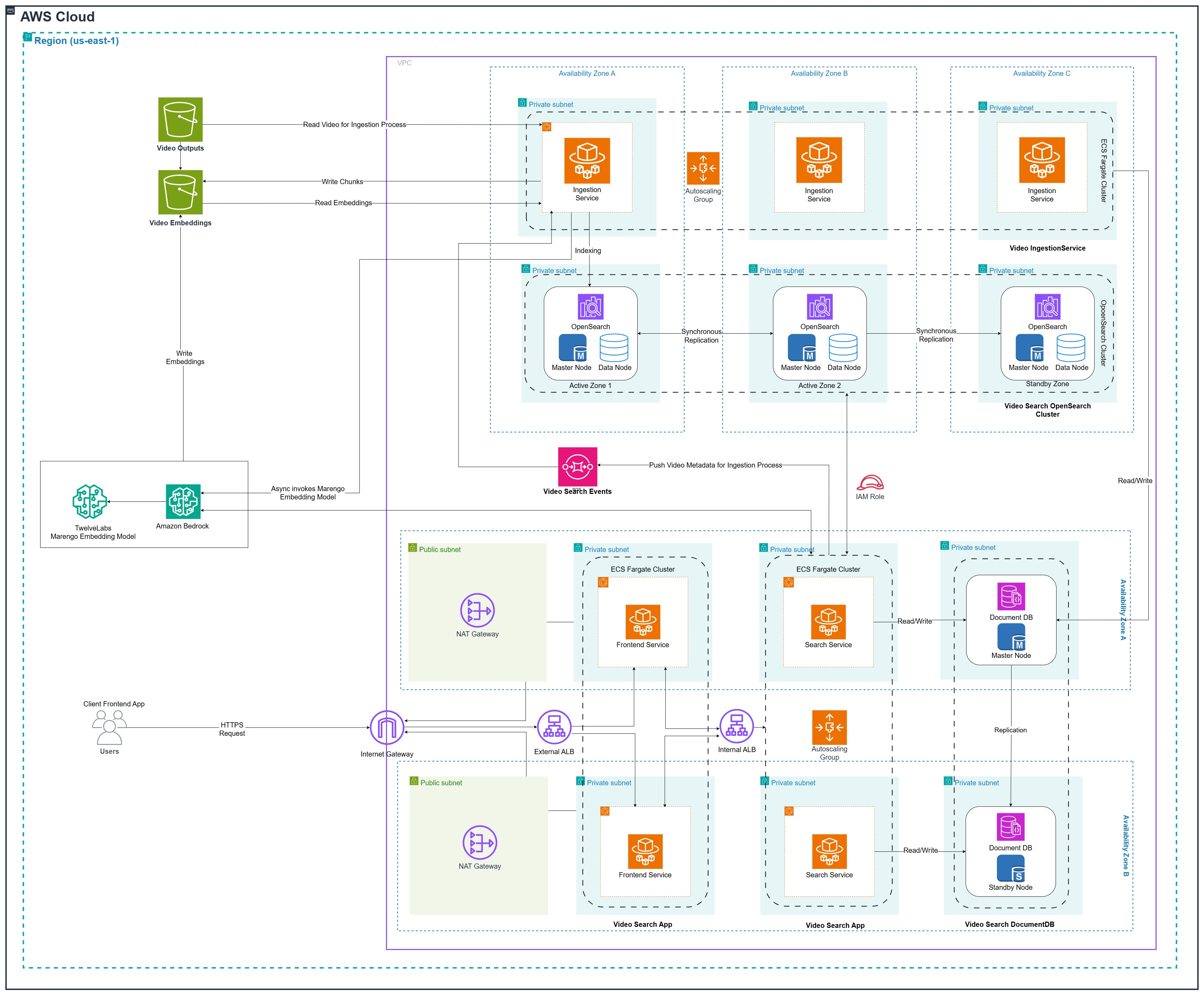
Condé Nast's editorial teams spent an average of 250 minutes per task searching a library of more than 140,000 videos using only titles and descriptions. Working with the AWS Gener…
AI 点评 · 媒体巨头用AI把14万视频库的检索从250分钟压到秒级,内容资产的智能化盘活正成为新战场。

Biology doesn't operate in silos, and neither should the AI representation of it. Quine is an early-stage research effort to create a multimodal world model of biology. By connecti…
AI 点评 · AI开始构建跨模态生物世界模型,有望打破数据孤岛,加速生命科学发现。
Traffic signal control (TSC) is essential for improving urban mobility and reducing congestion. Although roadside cameras are widely deployed at signalized intersections and provide rich visual observ…
Agents can learn from past executions, but enabling different agents to reuse and build on one another's experience remains challenging. We introduce EpiCon, a shared multimodal memory framework for a…
Long-form video understanding requires multimodal agents to iteratively gather evidence over many reasoning steps. However, most existing agentic methods suffer from semantic thrashing: as append-only…
Latent reasoning has advanced multimodal reasoning through a two-stage training paradigm: (1) a helper image is encoded into latent tokens to teach visual chain-of-thought during a supervised fine-tun…
Instruction-guided video editing has made significant progress, yet existing methods use multimodal large language models (MLLMs) primarily as semantic encoders, so they often fall short in working wi…
Reasoning about the 3D world from multi-view images remains a fundamental challenge for Multimodal Large Language Models (MLLMs). While modern MLLMs handle single-image inputs effectively, they strugg…
Unified Multimodal Models (UMMs) often rely on separate visual representations for understanding and generation, increasing visual context length and complicating integration with established vision-l…
Vision-language models (VLMs) are increasingly used in place of human annotators, making it important that substitutability tests reflect the model rather than incidental evaluation conditions. We int…
Audio-visual large language models (AVLLMs) have made remarkable progress in multimodal understanding and reasoning through interactions among visual, auditory, and linguistic information. However, re…
Vision-language-action (VLA) models have advanced robotic manipulation, but their zero-shot generalization in new tasks and environments remains limited, and their reliance on specialized training kee…
Vision-language-action (VLA) policies often fail when a robot's executed motion deviates from their commanded action. Such execution errors arise from the robot's mechanics and operating conditions, s…
Few-step streaming audio--video generation requires both causal modeling and step distillation, yet standard training recipes face two context-related challenges. Teacher forcing pairs clean history w…
Diffusion models can produce striking images and videos, but they still struggle with the compositional details that make a generation faithful to a prompt, such as object counts, attribute binding, s…
Vision-language (VL) pretraining using paired chest X-ray (CXR) images and radiology reports has shown strong potential for medical image understanding. However, existing methods often remain dependen…
Reasoning vision-language models (VLMs) process images and videos as long sequences of visual tokens, making inference expensive. Training-free token pruning reduces this cost, but aggressive compress…
When a VLM answers a visual query, current interpretability tools rely on text rationales, which use a mismatched modality, or on internal read-outs, which originate too early to reflect the final out…
Tool-based image editing (image retouching) is commonly formulated with autoregressive multimodal large language models (MLLMs) that sequentially generate reasoning, tool selections, and parameter val…
Multi-vector retrievers built on vision-language models lead visual document retrieval (VDR), but they run a multi-billion-parameter query encoder on every search. Distilling this encoder into a small…
Most modern multimodal large language models (MLLMs) build on a pretrained visual encoder that provides a strong visual prior. Encoder-free MLLMs instead learn visual representations directly from raw…
Vision-language-action (VLA) models perform well on shorter-horizon manipulation tasks but still struggle with long-horizon tasks that require multiple dependent manipulations from a single command. O…
Visual-token compression is effective for improving the efficiency of vision-language models, but under extreme compression budgets, token pruning can break visual grounding while learned resamplers i…
Recent vision-language models (VLMs) have advanced vision-and-language navigation (VLN), enabling models to predict navigation actions from visual observations and language instructions. In this work,…
Latent visual reasoning (LVR) enables multimodal large language models (MLLMs) to perform intermediate computation in continuous latent tokens rather than expressing every reasoning step in words. How…
Frontier models can now perform well on individual embodied navigation tasks through multi-round multimodal reasoning with simple tools. Across successive tasks, however, an agent must also rely on an…
Reinforcement learning (RL) is increasingly used to post-train vision-language-action (VLA) models, yet how RL reshapes these policies remains poorly understood. We find that RL across widely used flo…
Humans often solve spatial problems by mentally simulating visual transformations. In contrast, conventional vision-language models (VLMs) reason primarily through language. We investigate whether VLM…
Modern AI models are aligned through post-training to adapt them to downstream tasks. Recent work shows that fine-tuning language models on narrow tasks can induce emergent misalignment (EM), causing…
🚀🚀 A multimodal System One decision model that gives calibrated answers to typed questions about screens, photos, video and text in one forward pass.
A central goal in robotics is to enable manipulation across changing tasks and environments. Vision-language-action (VLA) models provide broad manipulation capabilities but can struggle when execution…
Multimodal large language models can expose task-relevant evidence through generation, but producing useful evidence does not by itself determine how it enters a retrieval embedding. We study whether…
Multimodal contrastive learning is a dominant paradigm for learning transferable representations from unlabeled data, but standard objectives primarily capture information that is redundant between mo…
Unified multimodal models combine understanding, generation, and editing within a single network, offering a promising foundation for versatile multimodal applications. However, growing multimodal con…
Long-term memory enables agents to accumulate information and reason across sessions, yet existing research primarily focuses on dyadic text or image-text conversations, leaving long-term memory for m…
Spoken conversational systems must recover information from prior interactions (i.e., memory), yet relevant information in speech extends beyond what was said to who said it, how it was spoken, and wh…
Multidisciplinary tumor boards integrate multimodal clinical observations and longitudinal patient histories through specialist discussions, yet benchmarks rarely capture these real-world trajectories…
Vision-language models are increasingly used to understand long videos and continuous streams. However, dense visual tokens accumulate with video duration, making long-context inference prohibitively…
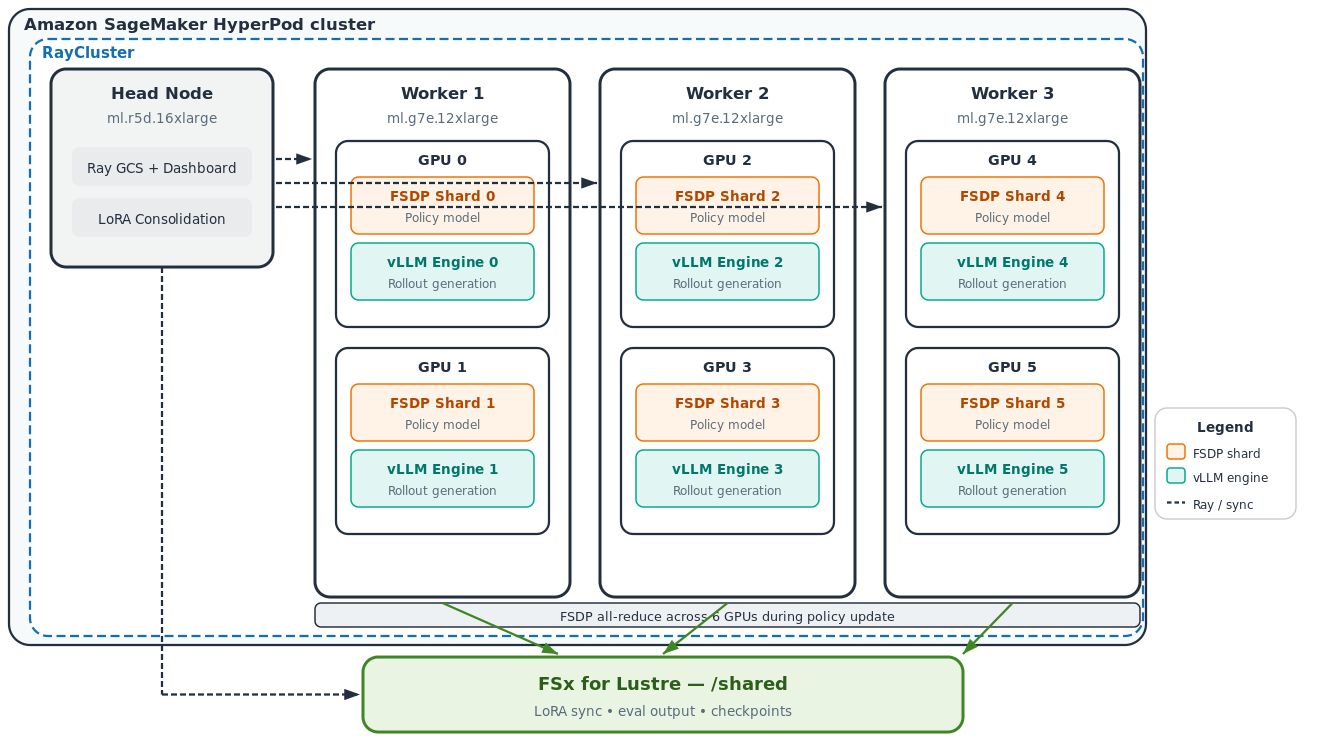
Learn how to run SkyRL, an open-source reinforcement learning framework, on Amazon SageMaker HyperPod to post-train a Qwen3-VL-8B vision-language model with GRPO. This walkthrough…
Large-scale Digital Surface Models (DSMs) can be produced cost-effectively from satellite images via stereo-photogrammetry. However, the resulting 3D maps are often contaminated by noise, outliers, an…
Urban uncrewed aerial vehicle (UAV) vision-language navigation (VLN) requires agents to follow instructions across extended urban spaces, inherently demanding long-term memory and geospatial grounding…
Recent research on Multimodal Sentiment Analysis (MSA) has focused on learning from language, visual, and acoustic modalities with incomplete data to infer human sentiment. Most studies typically comp…
Layer-wise visual-text similarity in Multimodal Large Language Models (MLLMs) is widely interpreted as evidence that the language model progressively integrates visual content into a shared representa…
General-purpose vision-language models (VLMs) bring broad knowledge and spatial reasoning to robot manipulation, yet existing systems either use them indirectly, to predict constraints or write progra…
Omni-modal agents must seek evidence across video, audio, web pages, and computation to answer questions. Their main bottleneck is planning: noisy multimodal observations accumulate in conversation hi…

Radical Numerics is using biological chain-of-thought and multimodal perception to keep up with the bio-defense arms race, design new genomes and gain insights into biology itself.
AI 点评 · 多模态让AI从辅助工具变为共创伙伴,内容生产正走向体验驱动。
Vision-Language-Action models provide a strong foundation for general-purpose robot control, yet a vast majority of policies do not preserve and leverage episode-level information beyond the current o…
Open infrastructure for training, evaluating, and deploying System 1 decision models across language and multimodal backbones.
OmniJev — multimodal finite-choice decision interface and MuJoCo embodied workbench: trajectory replays, decision probes, benchmark panels, 60s walkthrough.
Retrieval-Augmented Generation (RAG) systems over enterprise knowledge bases must ingest heterogeneous document formats -- PDFs, Word documents, presentations, and scans -- whose content is locked ins…
Vision-Language-Action (VLA) policies achieve strong performance in robotic manipulation but remain brittle once execution deviates from nominal trajectories. We propose CARE (Corrective Atomic Roboti…
Vision-Language-Action (VLA) models map observations to actions with no objective that accounts for how the world responds, so their robustness is bounded primarily by data coverage. World models carr…
Task planning bridges high-level instructions and executable behavior in long-horizon manipulation, yet modern Vision-Language-Action (VLA) systems often leave this intermediate structure implicit. Ex…
Manipulation policies must know which objects matter and where they are, yet the pretrained backbones that current robot foundation models build on, from language in vision-language-action models (VLA…

Qwen3.8-Omni-Flash is Qwen's first multimodal model designed for AI agents. It processes audio and video together and independently uses tools to edit vlogs, translate clips, or su…
AI 点评 · 国产多模态模型首次以低于谷歌的价格对标其性能,AI智能体音视频处理成本有望大幅下降。
Spatial reasoning is essential for vision-language models (VLMs) to understand and act in the physical world. Reasoning in dynamic environments requires VLMs to perceive local state transitions caused…
Vision-language models (VLMs) rely on storing and transferring appropriate information across their sub-components. Verifying that the VLMs exhibit desired behaviours, while avoiding harmful ones, is…
🚀🚀 A 0.8B JEV-like multimodal model playing GUI games directly from raw pixels.
We present MintAct, a family of vision-language models that unifies UI grounding, multi-step navigation across mobile, desktop, and web, and visual tool use, trained at 2B, 4B, and 8B scales. Through…
Pretrained vision-language-action (VLA) models enable broad manipulation but remain unreliable in tasks demanding precision and repeatability. Applying real-world online reinforcement learning (RL) to…
Action chunking is widely used for action generation and execution in Vision-Language-Action (VLA) policies, yet existing approaches commonly use a fixed action horizon. During a rollout, different ta…
Factory work is a promising early scenario for embodied AI: assigning repetitive manual jobs to robots has clear economic payoff, and a structured station keeps the jobs tractable for current policies…
Large vision-language models have achieved remarkable progress in multi-modal understanding, yet their capabilities in educational settings remain insufficiently evaluated. In AI-assisted language lea…
九大空间测试10B规模通用模型中8项第一
Enabling robots to adapt to unfamiliar environments as readily as humans remains a moonshot goal of embodied AI. No finite collection of demonstrations can cover every task and situation a robot will…
Intelligent systems that act in the world require image understanding that is both comprehensive and spatially grounded. Current vision-language models (VLMs) can generate fluent and detailed image ca…
Action tokenizers play a central role in autoregressive vision-language-action (VLA) models, determining both the targets for policy training and the executable commands recovered from predicted token…
Uncertainty estimation for Vision-Language-Navigation (VLN) models is a critical task since it can help identify ambiguous and unreliable predictions, enabling agents to make safer navigation decision…
A Multilingual, Multimodal Translation Model Family
Traditional multimodal representation learning and generation are two stages: a contrastive or self-supervised visual encoder is trained first, followed by a separate downstream generative model. This…
Slip detection is fundamental to dexterous manipulation, yet existing systems often lack precise characterization of detection latency and cross-platform generalization. We present SlipSense, a multim…
Deep networks trained on structural MRI for Alzheimer's disease (AD) staging often reach reasonable accuracy while attending to anatomically irrelevant regions, and multimodal models that add clinical…
TitanRAG - An open-source RAG infrastructure for building scalable, multi-tenant and multimodal AI applications.
A radiology report can already answer a clinical question, so it is hard to tell whether a vision-language model also uses the image. ModaLens, a paired image-swap audit, measures how report availabil…
We present PhysBrain 1.5, a unified model for understanding physical environments, generating actions, and predicting future states. Motivated by the physical loop of observation, interaction, and env…
Training prompts in online reinforcement learning (RL) differ substantially in how informative they are for the current policy: some are already saturated while others are too difficult to yield relia…
Multimodal agents can create complex videos in software such as Blender by coding without relying on diffusion models. Yet video understanding benchmarks still evaluate models mainly through question…
LynnReal-Omni brings text-to-video, image-to-video, human- and hand-pose guided generation, structural control, omni-reference generation, style transfer, video…
Can financial vision-language models (VLMs) turn chart evidence into reliable action recommendations? Existing hallucination evaluations are mostly claim-centric; they assess whether generated stateme…
Unified multimodal large language models (MLLMs) and multi-agent systems have advanced visual generation. However, three limitations remain. (1) Existing methods often distill task-specific experience…
Clinical timelines support treatment-window analysis and leakage-free modeling, but discharge summaries often obscure chronology and structured EHR tables describe only part of the patient course. We…
Visual goal and dynamics prediction can provide language-conditioned robot policies with both a target outcome and a representation of action-dependent scene changes. We bring these predictions into a…
Visual goal and dynamics prediction can provide language-conditioned robot policies with both a target outcome and a representation of action-dependent scene changes. We bring these predictions into a…
Camera traps often run in the field on edge hardware with limited or no connectivity, making small, locally-deployable vision-language models (VLMs) -- not frontier-scale ones -- the practically relev…
Continuous glucose monitoring (CGM) provides high-frequency measurements of glucose dynamics and enables short-term glucose forecasting for diabetes management. Although time-series foundation models…

Deepseek releases V4.1-Flash, a multimodal model with 552 billion parameters that cuts KV cache memory to a quarter of its predecessor. On the DeepSWE coding benchmark, it narrowly…
多模态AI大牛轮番登台,全球64支团队组团解题
We launch SenseNova-U1.5, an 8B-MoT native unified multimodal model that understands, reasons about, and generates visual content within an encoder-free and VAE-free architecture. We strengthen its vi…
An open-source, agent-native platform for multimodal AI generation, built on DeepSeek Harness. Every interaction lives in agent conversations and an infinite ca…
Foundation vision-language models (VLMs) exhibit broad intelligence about the world, yet translating this intelligence into robot control remains challenging. We present Show-Harness, an Embodied Harn…
Multimodal entity linking grounds entity mentions in text and images to knowledge-base entries. These systems degrade on rare entities, but prior work measures rarity primarily through popularity-base…
Reacting to sudden physical hazards (catching a slipping plate, dodging a falling knife) is both a meaningful test of embodied intelligence and a hard requirement for deploying multimodal large langua…
Diffusion large language models (dLLMs) achieve high decoding efficiency through block-parallel, arbitrary-order generation, making them attractive for latency-sensitive applications. GUI agents repre…
Image tokenizers define the ``visual language'' of unified multimodal models, yet are commonly studied through isolated metrics or generation-/understanding-only evaluations. These evaluations do not…
Visual encoders construct a representation of the image input for Vision-Language models. How much conceptual, as opposed to immediately visible, information does this representation contain? We use c…
Dexterous manipulation involves contact-rich and fine-grained interactions with the physical world, posing significant challenges for existing vision-language-action (VLA) models due to severe visual…
The digitization of healthcare has generated vast, longitudinal, and multimodal patient records over a lifetime, yet fully exploiting these data to represent and predict patient state trajectories rem…
We study the problem of navigating cluttered indoor environments with a humanoid robot. Unlike conventional methods that model navigation as a 2D path planning problem, humanoid traversal in cluttered…
Image tokenizers define the ``visual language'' of unified multimodal models, yet are commonly studied through isolated metrics or generation-/understanding-only evaluations. These evaluations do not…
全息闪卡通用 Agent Skill,不挑宿主、多模态模型都能用:一句话生成可拖转、会流光、带层次景深的 3D 闪卡网页,附可编辑 Blender 工程 · A host-agnostic Agent Skill: turn one sentence into an interactive 3D holographic…

We look at NeoMME, a family of 260M and 800M bidirectional encoders from H Company. Unlike ColPali-style retrievers, it processes multilingual text tokens and raw 32×32 image patch…
Robot foundation models are trained and evaluated predominantly in English, and robot demonstration corpora do not exist for most languages. We study the addition of Greek to an open vision-language-a…
Large Vision-Language Models (LVLMs) have achieved strong performance on diverse visual tasks, yet their ability to reconstruct and reason about the 3D structure of the scene depicted in 2D images --…
让机器人学会利用更长的多模态Context
AI 点评 · 具身智能与上下文学习结合,开辟大模型新赛道,看点足。
Robotics vision SDK
Latent visual reasoning aims to perform multimodal reasoning through hidden-state computation rather than explicit textual chains of thought. However, visual information being present in a latent stat…

IT之家 9 月 5 日消息, 在 Ox Alpha 确认为 GLM-5.3-Flash 原生多模态模型后 ,又一款名为 Omen Alpha 的模型昨日(9 月 4 日)上线 OpenCode Go 订阅计划 ,种种线索表明同样来自智谱公司。 费用方面,该模型目前仅对 OpenCode Go 订阅用户开放,月费 10 美元 (IT之家注:现汇率约合 67.…
AI 点评 · 智谱连推匿名模型,或预示多模态矩阵加速扩张,订阅模式成新战场。
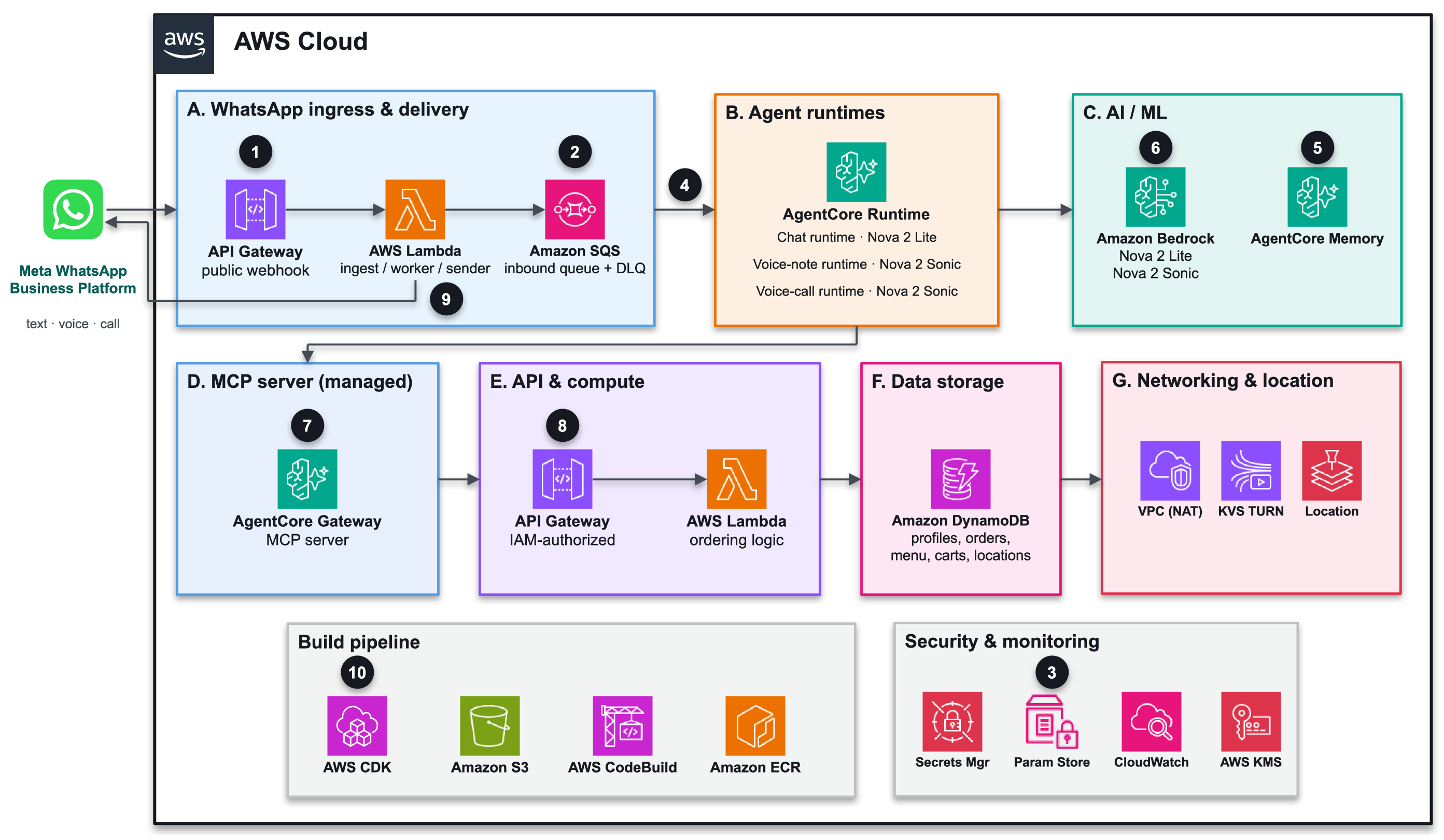
Learn how to deploy a multimodal WhatsApp ordering assistant that takes customer orders through text, voice notes, and real-time voice calls on a single business number, built on A…
AI 点评 · 多模态客服落地新范式,打通文本语音通话全渠道,企业部署可快速复制。
Multimodal Large Language Models (MLLMs) perform strongly on general visual understanding tasks such as visual question answering, yet they often struggle with a basic comparative skill: identifying w…
Grounding natural-language instructions into reliable and executable actions remains a fundamental challenge for vision-language-action (VLA) systems on mobile robots, due to the persistent gap betwee…
Multimodal Large Language Models (MLLMs) often struggle with hallucinations, thus hindering their reliable practical applications. Existing attention-based mitigation methods mainly rely on indirect s…
Vision-language models are increasingly used as reward functions for robotic learning, but this role requires paraphrase invariance: the same trajectory should receive the same reward under semantical…
Official repository for the paper "AdaptVPR: Route-Aware Hard Positive Generation for Robust Visual Place Recognition".
Vision-language models (VLMs) are expected to respond helpfully to appropriate requests while withholding compliance with requests that are incorrect, unsafe, infeasible, or unanswerable. However, exi…
Vision-Language-Action (VLA) models have shown promising progress in language-conditioned robotic manipulation. However, existing datasets and benchmarks mainly evaluate task completion under predefin…
Weakly-Supervised Dense Video Captioning aims to localize and describe multiple events in untrimmed videos given only an ordered set of event-level captions per video. Recent work synthesizes auxiliar…
World Labs 发布多模态世界模型 Atlas、阿里千问推出 Qwen3.8-Max-0902 等。 查看全文
We propose Puffin-World, a unified multimodal architecture that integrates physical understanding, spatial simulation, and 3D world generation and reconstruction without relying on external offline mo…
Streaming video understanding requires multimodal large language models (MLLMs) to process continuous visual inputs and respond to user queries under strict causality and bounded memory. Existing appr…
We introduce LLaDA-Image, a unified framework that pairs a 6B Diffusion Transformer (DiT) trained from scratch with a frozen vision-language understanding module built on the LLaDA2.0-Mini diffusion l…
Despite the remarkable prowess of Vision-Language Models (VLMs) in general multimodal tasks, they remain fundamentally ``flat'' when reasoning about the physical world. We argue that this spatial bott…
一张图补全3D世界,还能给机器人造训练场
Most current vision-language-action (VLA) models—such as OpenVLA, π0, RT-2, and RDT-1B—are “monolithic.” This means they generate raw motor commands or very short sequences of acti…
Long-horizon manipulation is partially observable: the information needed to choose the next action may appear only in observations from minutes earlier. Existing memory mechanisms: retrieval banks, l…
Vision-Language-Action (VLA) models demonstrate strong generalization in robotic manipulation and navigation, but existing fine-tuning methods provide limited safety guarantees. Current approaches pri…
Vision-Language Models (VLMs) provide useful priors for interactive decision-making, but using them directly as policies is expensive and brittle: they must be queried at every step, do not improve fr…
A structured, continuously updated atlas of post-training research across language, agents, multimodal models, generative media, and embodied intelligence.
Multimodal Large Language Models (MLLMs) are strong perceivers of images and video. We ask how far that reach extends into acting: dropping an MLLM directly into a drone's control loop, with its entir…
While unified multimodal models (UMMs) jointly perform visual understanding and generation within a single model, functional unification does not guarantee learning synergy: the two objectives may rei…
Multimodal memory offers a scalable interface for long-video question answering, but existing methods often retrieve captions, frames, transcripts, summaries, or graph facts as isolated fragments. Alt…
An image may be worth a thousand words, but most captioning models describe it in only a few. Modern vision-language models produce fluent high-level captions, yet routinely miss the attributes, count…
Vision-language-action (VLA) models map visual observations and language instructions directly to robot actions, but long-horizon tasks require more than action prediction. An agent must coordinate pe…
Accurate daily predictions of cold hardiness in woody plants are critical in regions where freezing temperatures can damage dormant buds and reduce seasonal yield. Existing biophysical, hybrid, and de…
Hi HN, we’re Brandon and Kingston, the founders of Hebbian Robotics. We built HFlow ( https://github.com/Hebbian-Robotics/hflow ), an SDK that turns multimodal recordings from robo…
Learn and build modern AI in one native PyTorch stack: LLMs, VLM/VLA, diffusion & flow matching, world models, and agents—with LoRA, RL post-training, distillat…
Embodied navigation requires agents to translate heterogeneous goals and visual observations into actions across tasks, environments, and robot embodiments. Modern vision-language models (VLMs) alread…
VLM-driven self-improvement of web code has a structural flaw: the model that proposes the repair is the model that judges it, and visual plausibility under that judge is a poor proxy for whether the…
Visual instruction tuning is crucial for advancing the vision-language alignment and instruction-following capabilities of Vision-Language Models (VLMs). However, identifying optimal subsets under a f…
Strategic deception by LLM and VLM agents has emerged as a central AI alignment and safety concern. Social-deduction games (where each player holds a hidden role and communicates with others to deduce…
Long-horizon physical-world agents must reason over distant goals while grounding decisions in reliable closed-loop behavior. Today's foundation models split these capabilities: vision-language models…
Multimodal geometry reasoning requires VLMs to extract precise visual relations and preserve them through multi-step deduction. Existing free-form traces obscure the decisions that determine the answe…
We present Qwen-Drive-1.0, an initial step towards a vision-language foundation model for autonomous driving. Qwen-Drive-1.0 retains the architecture of the pretrained vision-language model (VLM) and…
Multimodal models often build on architectures designed for generative vision-language modeling, typically combining separately pretrained vision encoders with causal language models. Visual document…
A collection and analysis of multimodal fake news datasets across languages, domains, platforms, and modalities.
Multimodal misinformation on social media is highly prevalent, potent, and harmful, yet difficult to detect and counter, and still poorly understood compared to its text-only counterpart. Research on…
Detecting hallucinations in Large Vision-Language Models (LVLMs) requires both accurate span localization and well-calibrated confidence scores. Fine-tuned generative VLMs excel at identifying halluci…
Mobile AI acts as a visual oracle, empowering users to snap a picture of something and ask for information. Snap-and-ask retrieval is now one of the most common entry points for mobile AI, yet photos…
We look at Gemini Omni 1.1 Flash, Google's production update to its native multimodal video generation and editing model. We break down what changed: scene extension now reads up t…
AI 点评 · 原生多模态视频编辑升级,场景延长与4K增强直击创作痛点,实用价值显著。
Recent work on image content manipulation based on vision-language pre-training models has been effectively extended to text-driven 3D scene editing. However, existing schemes for 3D scene editing sti…
Multimodal safety moderation requires distinguishing risks arising from visual content, user intent, and assistant behavior. Existing safeguards, however, are typically trained for a single judgment t…
Perplexity AI 推出 Portable Computer,明基推出 Creative Pro PV50 系列专业显示器。 查看全文
AI 点评 · 开源多模态新模型降低门槛,开发者可低成本接入,推动AI应用创新加速。
Spatio-temporal video grounding (STVG) requires models to identify when a referred event occurs and localize the target entity throughout that interval. Existing multimodal large language models typic…
Verifiable handwriting synthesis for failure-driven multimodal training and regression.
Qwen3.8-Flash-Next Another open weights model from Qwen. This one is "a multimodal MoE model that also serves as an early preview of the architecture used in Qwen4". It's pretty bi…
Z.ai has released GLM-5.3-Flash, the first natively multimodal model in the GLM-5 series — a 320B-total / 18B-active MoE with a 1,048,576-token context window, MIT-licensed weights…
AI 点评 · 原生多模态与百万级上下文兼得,MIT协议开源,或重塑企业级AI应用门槛。
Explicit visual intermediates can help multimodal large language models (MLLMs) externalize spatial evidence and updated visual states, but their utility depends on whether an image editor can faithfu…
Multimodal large language models (MLLMs) can interpret a street view, but urban agency depends on whether such local evidence remains useful after the agent starts to move. In this paper, we investiga…
Scaling robot data is crucial for building generalist Vision-Language-Action (VLA) models, yet robot trajectories are harder to scale than web-scale image-text data because embodied collection is cost…
Physical understanding and reasoning depend on forming compact and generalizable representations of the world. While modern vision-language models can recognize and explain diverse physical events, th…
Multimodal GUI agents have emerged as a promising paradigm for digital task automation, yet transitioning from benchmark-oriented models to dependable real-world applications remains challenging due t…
In this paper, we explore a novel task of Multimodal Unsupervised Continual Post-Training (MU-CPT), enabling deployed MLLMs to continually evolve from streaming unlabeled data. Existing unsupervised p…
Civil infrastructure compliance checking has long relied on engineers manually reading legacy 2D plans; however, OCR-based automation strips away the geometry and layout essential for interpreting the…
GLM-5.3 Flash
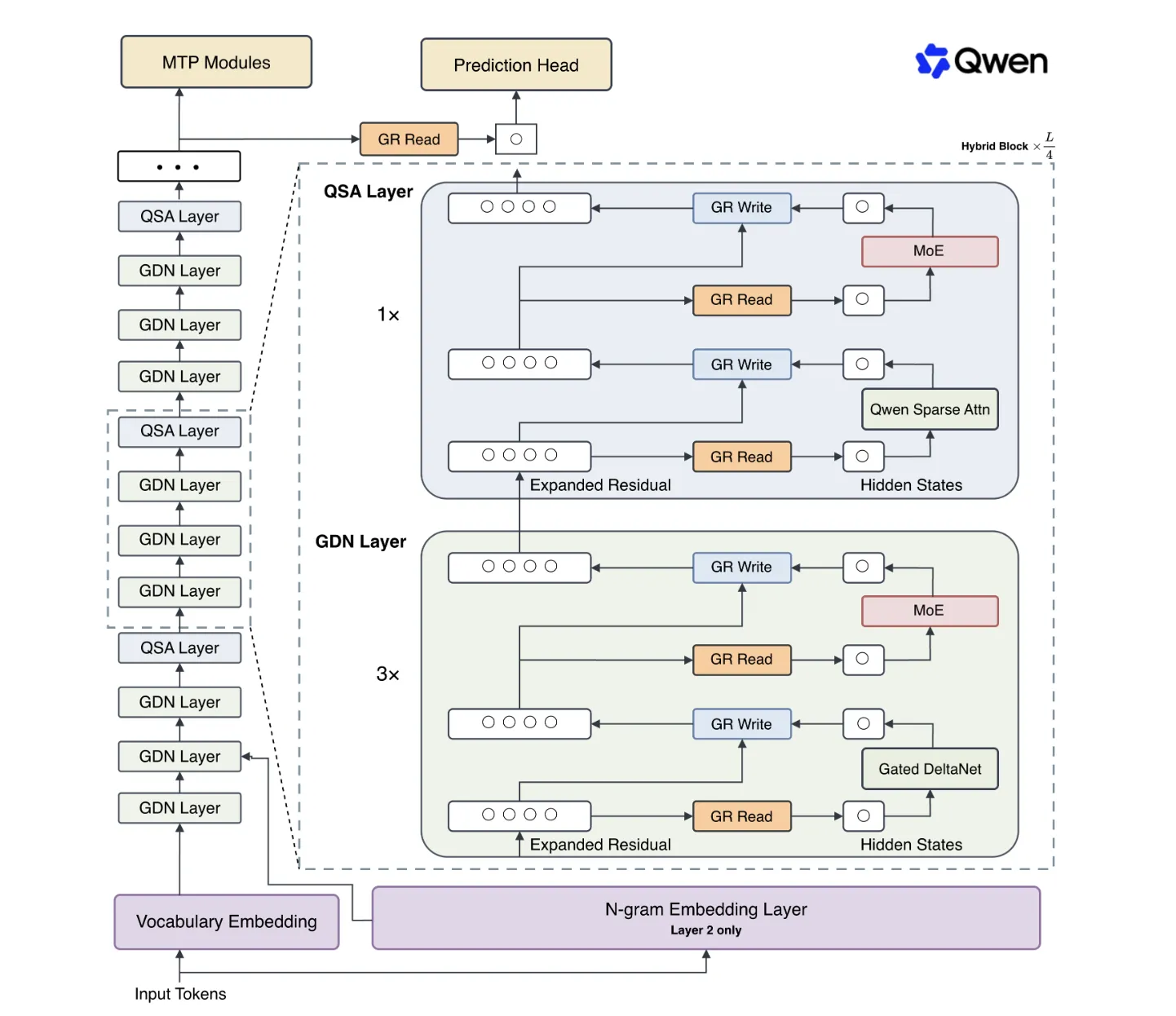
We look at Qwen3.8-Flash-Next, Alibaba's open-weight multimodal Mixture-of-Experts model and an early preview of the Qwen4 architecture. We break down where the 180B parameters act…
Halo is an open-source framework built by White Circle for training large language and multimodal models
**Z.ai** launched **GLM-5.3-Flash**, a natively multimodal model with a **1M-token context window**, **320B total parameters / 18B active parameters**, under the **MIT License**. I…
Generative vision-language models (VLMs) are increasingly used in human-centered settings, yet they can produce demographically biased outputs even when images differ only in controlled attributes suc…
Document retrieval increasingly supports high-stakes information access in finance, healthcare, and law. Modern retrieval pipelines vary both in modality (text or multimodal) and in retrieval architec…
Multimodal Large Language Models (MLLMs) have shown strong performance in video understanding. However, their ability to follow instructions in this domain remains under-explored. Real-world video und…
Multi-arm collaboration is becoming a core capability in embodied manipulation. Recent vision-language-action (VLA) models integrate perception, language, and control, but most represent language as a…
Vision-Language-Action (VLA) models have demonstrated effectiveness in robot manipulation, yet state-of-the-art models such as pi0.5 operate under a single-frame paradigm, limiting their ability to re…
Vision-language models can produce fluent answers that are insufficiently grounded in the visual evidence: a single unsupported object, chart value, or intermediate inference can undermine an otherwis…
Contact-rich manipulation requires adapting to contact states that can evolve substantially within an action horizon. However, chunk-based vision-language-action models predict complete action chunks…
Evaluation is shifting from static QA toward agentic settings where models act through external tools. We identify a critical yet underexplored capability within this space - dexterous visual tool use…
A zero-dependency Python tool to resolve relative Markdown links and inline images as Base64 strings for RAG and Multimodal LLMs.
WeMM-Embedding is a family of universal multimodal embedding models by the WeChat Vision Team at Tencent, supporting multimodal understanding and retrieval.
Unified multimodal models that understand, reason over, and generate interleaved text–image sequences remain structurally fragmented: existing approaches either sacrifice visual fi…
We present LAION-BVD, a large-scale open video dataset for multimodal learning, which contains 1.3B platform-specific video URLs collected from CommonCrawl. From these, we download 80M videos with a t…
Universal multimodal embeddings are becoming a core component of modern AI systems, enabling heterogeneous content to be represented in a shared space for applications such as retrieval, recommendatio…
Large vision-language models have shown strong progress in UI-to-code generation, yet their test-time self-evolution remains unstable. We first identify a fundamental obstacle, termed visual repair co…
Multimodal large language models (MLLMs) can integrate long visual histories, reason under partial observability, and infer behavior from a few examples. Yet vision-language-action (VLA) models genera…
Multimodal large language models increasingly use visual chain-of-thought (Visual CoT) to reason about spatial, temporal, and embodied environments. By generating intermediate reas…
Large-scale vision-language models (VLMs) have demonstrated remarkable versatility across a wide range of multimodal tasks. However, understanding humor remains challenging because humorous content of…
Vision-Language-Action (VLA) models can turn multimodal context into robot actions, but their action decoders are still trained largely by behavior cloning. This supervises which motor command was dem…
Computer-use agents ground natural-language instructions in screenshots to locate interface elements, yet existing benchmarks do not isolate whether models bind relational language to the correct elem…
Turn-taking is a basic organizational feature of human conversation and remains difficult to model in natural, synchronous dialog systems. While existing research has explored multimodal approaches an…
AI 点评 · 多模态补齐视觉短板,AI应用场景迎来新变量。

Deepseek has released V4-Flash-Vision-Exp, an experimental multimodal model that adds image understanding to V4-Flash's text capabilities. On the company's own multimodal agent ben…
AI 点评 · 视觉增强直逼顶级闭源模型,开源生态再添利器,值得关注。
Reinforcement Learning (RL) has demonstrated significant gains in image captioning, yet it is still limited in encouraging Large Vision-Language Models (LVLMs) to explore novel reasoning strategies. T…
We present PhysCaP, a Physics-Informed Code-as-Policy agent for active perception in robotic manipulation. While vision-language-action policies excel at imitating demonstrations, they rely on passive…
Real-world image search queries are multimodal and compositional: ``find this shirt in pink'' specifies an entity to retain, an attribute to modify, and context to ignore. Yet existing re-rankers eith…
Simulating realistic user shopping behavior underpins offline evaluation and reinforcement learning in e-commerce scenarios. While recent LLM- and VLM-based simulators have made encouraging progress,…
Deploying vision-language models (VLMs) on mobile devices is challenging due to their significant memory and compute requirements. We present a framework for quantizing VLMs for efficient inference on…
Deep face recognition (FR) models reach near-saturated accuracy but remain opaque: a practitioner cannot ask which semantic attributes a similarity score relied upon. EXPL-FR answers this inside the F…
Reliable spatial understanding is an important prerequisite for future medical vision-language systems that aim to support radiological report generation and structured image understanding. While mode…
How to efficiently finetune robot policies to learn new tasks on the fly? State of the art robotic manipulation policies are based on behaviour cloning of large vision-language-action (VLA) models wit…
Multimodal large language models (MLLMs) have become a prevailing paradigm for unified video perception. However, post-training on large multi-task datasets remains challenging, as existing reinforcem…
Reinforcement learning (RL) has emerged as a powerful approach for improving reasoning in language and vision-language models, yet its strongest successes still depend heavily on ground-truth supervis…
AI 点评 · 多模态实时交互突破,AI通话体验迎来质变。
Vision encoders are a critical component of vision-language models, and scaling their capacity effectively improves performance. However, dense scaling increases compute cost and inference latency. Mi…
Although Large Vision-Language Models (VLMs) have significantly advanced embodied navigation, their direct deployment remains challenging, as existing methods often force VLMs into unnatural action sp…
Long-horizon robot manipulation chains many contact-rich skills into one multi-stage task. Vision-language-action (VLA) models increasingly master the individual skills, yet the chain still fails: err…
Humanoid robots hold great promise as general-purpose agents in human-centered environments, yet generalist vision-language-action (VLA) foundation models are not readily applicable to humanoid whole-…
Despite recent advances in unified multimodal models for multi-reference image generation, existing benchmarks remain organized around predefined task types (e.g., "subject composition"), which are il…
Long-horizon robot manipulation requires a robot to both execute individual skills reliably and sequence them coherently over extended tasks. Most hierarchical vision-language-action (VLA) models make…
Hybrid-thinking multimodal large language models (MLLMs) allow a single model to alternate between deliberative thinking and latency-efficient non-thinking inference. Although these modes differ in re…
Multimodal large language models increasingly use visual chain-of-thought (Visual CoT) to reason about spatial, temporal, and embodied environments. By generating intermediate reasoning images, Visual…
Visual document retrieval is a critical component of multimodal retrieval-augmented generation, aiming to identify query-relevant pages from document collections where evidence is distributed across t…
Vision-language-action (VLA) models have become a dominant paradigm for generalist embodied agents, demonstrating strong complex and long-horizon task completion in structured settings. Yet it remains…
AI 点评 · 多模态长上下文推理瓶颈突破,行业落地效率关键。

Moonshot AI's PerceptionBench tests how well multimodal AI models can actually "see," separate from logical reasoning. No frontier model reaches 60 percent accuracy, and GPT-5.6 So…
We present MOSS-VL, an open vision-language model family that treats real-time interaction -- perceiving while it speaks -- as a first-class capability. It is co-designed across the stack: the languag…
Constructing an interactive 3D open world from a user query is important. However, existing methods are primarily evaluated on idealized, simple queries, making it difficult to systematically analyze…
Vision-language models (VLMs) enable embodied agents to reason and act from visual observations and language instructions. Reinforcement learning (RL) post-training enhances these capabilities using t…

IT之家 8 月 14 日消息,今天(14 日)晚间,阿里“千问大模型”公众号宣布,Qwen3.8-27B 模型正式开源,所有开发者、科研机构和企业均可自由下载、部署和使用。 IT之家附体验地址: Hugging Face 魔搭社区 根据介绍,27B(270 亿参数)是 全球 AI 社区呼声最高 的模型尺寸,Qwen3.8-27B 是原生多模态稠密(Dens…
AI 点评 · 开源27B尺寸兼顾性能与部署成本,编程办公双场景越级表现,或成中小开发者首选。
Scientific figures and tables encode essential experimental evidence, yet remain difficult for digital libraries and multimodal AI systems to retrieve and interpret. The ALD/E-ImageMiner benchmark and…
Near-native image understanding for DeepSeek Harness
Near-native image understanding for DeepSeek Harness
Spatial perception and reasoning from visual observations require recovering geometric structure, establishing correspondences, and understanding spatial relations. Existing approaches typically addre…
Eyes for text-only DeepSeek Harness agents: built-in free vision chain (no key) + pixel-level vision tools (Q&A, grounding, crop, pixel diff, colors, OCR, SVG t…
Liquid AI released LFM2.5-VL-3B, a 3.1B-parameter vision-language model built for on-device deployment. It averages 80.7 on ScreenSpot-v2 and lifts RefCOCO grounding from 57.1 to 8…
Spatial intelligence is becoming a foundation for embodied agents, robotic planning, and multimodal assistants. To improve the spatial reasoning ability of VLM agents, existing work has mainly followe…
Transforming multimodal sources into condensed and structured media outputs can be fundamentally conceptualized as a long-horizon agentic process centered on a model-harness system. While an ideal har…
Document parsing aims to transform unstructured documents into structured and machine-readable representations. Recent advances in Vision-Language Models (VLMs) have significantly advanced document pa…
Aerial vision-language navigation (VLN) requires an embodied agent to integrate visual evidence over time, plan future actions, and determine when it has reached a navigation goal under partial observ…
Multimodal Large Language Models (MLLMs) have been growing the capability for scientific writing and collaboration. For example, OpenAI Prism is a free workspace for scientific writing and collaborati…
免训练、开箱即用!
Agentic systems powered by large language models (LLMs) have opened new opportunities for business ideation. Yet existing approaches remain confined to a text-only paradigm, despite the inherently mul…
While Multimodal Large Language Models (MLLMs) have achieved remarkable progress, visual understanding and generation are typically treated as divergent objectives. Existing unified frameworks often r…
Video understanding is a fundamental task for evaluating the capabilities of multimodal large language models (MLLMs). However, existing leading models have already achieved approximately 90% accuracy…
Existing Multimodal Large Language Models (MLLMs) predominantly rely on image-text pairs for modality alignment pretraining, mapping global image representations to long textual descriptions. However,…
Large Vision-Language Models (LVLMs) achieve impressive visual reasoning and dialogue capabilities, yet frequently hallucinate content unsupported by the visual input. Effective mitigation requires to…
In this comprehensive guide, we demonstrate how to implement a complete, programmable MiniMax-H3 multimodal generation pipeline. By leveraging ComfyUI as a headless backend, we wal…
Omni-modal dialogue models can understand multimodal inputs and synthesize spoken replies, yet their responses remain visually disembodied. We introduce Ex-Omni-2D, an omni-modal dialogue framework th…
Multimodal Large Language Models (MLLMs) exhibit strong visual understanding, yet the internal features that cause these behaviors remain difficult to identify, audit, or control. While applicable to…
Large Vision-Language Models (LVLMs) have demonstrated strong performance on multimodal benchmarks, yet it remains unclear whether they genuinely reason about relationships between images and text or…
AI 点评 · 看点多模态模型深层推理能力,直击“真懂”还是“假会”的评测盲区。
Introducing Muse Glimmer: open-weight 30B agentic multimodal model that runs on your device (Meta). Interactive local agent lab + guide. Apache 2.0 · on-device…
**Meta** re-enters the open-weight frontier with the release of **Muse Glimmer**, a **30B dense**, multimodal, agent-focused model under **Apache 2.0**, optimized for always-on loc…
Multimodal Large Language Models (MLLMs) exhibit strong visual understanding, yet the internal features that cause these behaviors remain difficult to identify, audit, or control. While applicable to…
OpenCode skill suite for MiniMax H3 directing, routing, multishot planning, prompt generation, and review.
We present VectraYX-Vision-1B, a sub-2B vision-language model (VLM) for Spanish/LATAM cybersecurity imagery, coupling a frozen SigLIP-so400m encoder to a 1.04B Spanish/LATAM security decoder via an ML…
Semantic vision encoders have become a central visual interface for multimodal understanding and semantic conditioning in image generation. However, their final tokens discard fine-grained visual deta…
Mistral AI has released Shieldstral 1.0 3B, an open-weights, policy-adaptive multimodal safety classifier that frames content moderation as a single yes/no question instead of a fi…
In this tutorial, we build an advanced multimodal retrieval-augmented generation pipeline with NVIDIA NeMo Retriever. We begin by configuring a Python 3.12 environment, installing…
Vision-Language Models (VLMs) should answer from concrete image evidence rather than language priors, dataset shortcuts, or irrelevant visual context. Existing perception-aware post-training methods e…
Vision-language grounding connects language to visual content, yet most existing formulations reduce grounding to a unidirectional localization problem: given a prespecified text phrase or category na…
Multimodal expansion of large language models (LLMs) enables new perceptual capabilities but often compromises the language intelligence acquired during pretraining. In this work, we investigate this…
Vision-language models (VLMs) are improving rapidly, but benchmark development lags behind, making weaknesses hard to identify. Building stress tests is costly: samples must satisfy controlled conditi…
LLM inference accounts for over 90% of AI operational energy, scaling directly with input token count---a critical inefficiency for telecom network analytics and numerical time-series data analysis (N…
Vision-language models are increasingly serving as the reasoning core of embodied agents. Robot execution is inherently iterative: each action reshapes the scene and physical state, continually renewi…
While Vision-Language-Action (VLA) models have advanced embodied AI, their fundamentally reactive paradigm severely limits performance in partially observable and long-horizon tasks. When restricted t…
Visual-token pruning can substantially reduce the inference cost of multimodal large language models (MLLMs), yet existing methods largely rely on fixed, handcrafted heuristics and costly expert trial…
Latent diffusion modeling (LDM), a prominent paradigm, utilizes tokenizers to map input signal to compressed representation. This dependency positions tokenizer as an integral part of generation proce…
Unified multimodal retrieval aims to identify candidates that satisfy complex user intent expressed through heterogeneous inputs. Although Large Vision-Language Model (LVLM)-based retrievers are effic…
Multimodal large language models excel at passive perception but struggle with complex visual cognitive tasks requiring multi-step temporal reasoning. This degradation largely stems from the inherent…
Vision-Language-Action (VLA) models have become a powerful paradigm for robot manipulation, but training a single generalist policy for heterogeneous robot embodiments remains an open problem. Existin…
Multimodal Large Language Models (MLLMs) have demonstrated remarkable capabilities in emotional intelligence. However, prevailing research predominantly focuses on task-specific specialization, often…
Recent works train agents by constructing large-scale multimodal environment pools. However, we find that simply increasing the number of multimodal environments does not always benefit. We further an…
Deploying autonomous multimodal agents in continuous, real-world environments requires them to ingest unbounded audio-visual streams and maintain hour-scale memory. However, current evaluations predom…
The "thinking-with-images" paradigm equips multimodal LLMs with active visual operations such as crop-and-zoom. However, models using these operations often achieve only marginal or negative gains ove…
Data assimilation (DA) uses Bayesian inference to update the state of a numerical forecast model with observed data. In this study, we propose a fundamentally different, unified approach to atmospheri…
NVIDIA released Alpamayo 2 Super, a 34B vision-language-action model for autonomous driving, under OpenMDW-1.1 — a permissive license covering fine-tuning, derivatives and commerci…
MCP server that gives text-only LLM coding agents vision — analyze images via any multimodal model (mimo, Claude, Gemini, OpenAI-compatible). Works with Claude…
GUI agents must remember both useful experience from earlier tasks and unfinished progress in the current interaction. Latent memory offers a compact solution by compressing multimodal trajectories in…
Leveraging pre-trained vision-language models (VLMs) to construct vision-language-action (VLA) models has emerged as a promising paradigm for 3D robot manipulation. However, existing 3D VLA methods re…
Memory-augmented VLM agents act on persistent spatial knowledge, yet that knowledge silently goes stale as the environment changes. We ask what happens when an agent must reconcile a confident memory…
Text-to-image (T2I) models can produce visually compelling images, yet they remain limited on open-world tasks that require complex semantic understanding, multi-step reasoning, and the integration of…
Vision offers a critical axis for advancing foundation models, driving a shift towards natively unified multimodal pretraining. Despite this momentum, the design space and the fundamental mechanisms o…
On-Policy Self-Distillation (OPSD) has become a standard post-training approach for improving visual reasoning in multimodal large language models (MLLMs). Existing methods draw privileged information…
Vision-language-action (VLA) models often treat main-view and wrist-view observations as parallel visual inputs, overlooking their distinct roles in robot manipulation. Fine-grained manipulation, howe…
Existing scaling strategies for Multimodal Large Language Models (MLLMs) typically expand either model parameters or sequential inference computation, incurring substantial memory or latency overhead.…
Shieldstral introduces a 3B open-weights multimodal safety classifier that outperforms models up to 7x its size.
文 | 李炤锋 编辑 | 张雨忻 “长链任务如果只通过代��层面的反馈,误差可能会不断累积,最终效果会非常差。”谈及原生多模态的意义,一位多模态研究员表示,“视觉是一种更准确的反馈,也更贴近用户意图。” 过去一年,Coding与Agent能力不断改写大模型的排名,也成为AI最快兑现商业价值的场景之一。与此同时,随着Agent开始接管更多长链任务,越来越多的通…
**Alibaba** launched **Qwen3.8-Max**, enhancing multimodal capabilities and agent ecosystem integration. **NVIDIA** introduced **Alpamayo 2 Super** for autonomous vehicle reasoning…
We introduce Video-DeepResearch (Video-DR), extending multimodal agents from static images to continuous video streams, a setting that demands dense spatiotemporal grounding coupled with open-web expl…
Multimodal large language models (MLLMs) make grounded predictions in real-world scenes by combining visual and textual cues, yet existing benchmarks rarely reveal how they arbitrate between these evi…
Flow-matching vision-language-action (VLA) models such as pi0 generate robot actions by integrating a learned denoising velocity field, and have been reported to resist adversarial perturbations that…
LLM agents are increasingly applied to open-ended everyday requests that span work, study, and life. These tasks are long-horizon, cross-environment, and multimodal, forcing the agent to preserve goal…
**Alibaba** launched **Qwen3.8-Max**, a **2.4T-parameter** open-weight model emphasizing autonomous coding, long-horizon execution, and multimodal feedback, with aggressive pricing…
编程、专业工作、长程任务、多模态分析统统梭哈
Preference alignment has become a crucial component in enhancing the performance of Large Language Models (LLMs), yet its impact in Multimodal Large Language Models (MLLMs) remains…
Multimodal large language models (MLLMs) have advanced visual understanding and reasoning, yet their static parametric knowledge limits their ability to address knowledge-intensive and dynamically evo…
Sparse retrieval underpins modern search systems, from web search to retrieval-augmented generation. Existing work has introduced Learned Sparse Retrieval (LSR) to push beyond exact lexical matching t…
Recent Vision-Language-Action (VLA) models for autonomous driving (AD) increasingly utilize chain-of-thought (CoT) supervision to enhance the reasoning capabilities of their Vision-Language Model (VLM…
Chart question answering (CQA) requires multimodal large language models (MLLMs) to integrate visual comprehension with logical reasoning, yet current models struggle with accurate visual grounding an…
Scientific poster construction compresses a long multimodal paper into a readable, editable canvas. Existing systems hide request-level failures by scoring only completed outputs; direct image generat…
Captions serve as a primary supervision signal for both multimodal understanding and text-to-image generation. However, previous evaluations treat the caption quality as a single scalar objective, whi…
Recent advances in image generation have demonstrated the potential of unified multimodal models that integrate understanding, generation, and editing. However, unified 3D modeling remains constrained…
Robot learning is splitting into two bets: policies that bake competence into frozen weights (vision-language-action, or VLA, models), and agents that write and refine their own executable skills as c…
Multimodal representation learning is a cornerstone of modern AI. By encoding multimodal queries and targets into vectors, it powers industrial search and recommendation and underpins modern agents. R…
Multimodal clinical models are usually judged on accuracy with every modality present, but deployment removes modalities; an echocardiogram is often unavailable where an ECG is routine. Two questions…
Recent 3D vision-language models (3D VLMs) construct geometry aware tokens by projecting 2D visual features into world coordinates, enabling spatial reasoning for tasks such as 3D question answering.…
Vision-language MoE batches contain different numbers of image and text tokens. Image resolution, image count, tiling, and prompt length all change this token mix. We call the standard token-level Swi…
Multimodal Large Language Models (MLLMs) have achieved strong performance on a wide range of vision-language tasks, but often fail under imperfect or shifted contexts. A reliable MLLM should refuse tr…
Density modes provide a localized and interpretable summary of multimodal distributions, but their estimation under rigorous differential privacy constraints remains largely unexplored. We study diffe…
Traditional static assessments rely on a subtractive, deficit-based grading model that often penalizes ambition and obscures diagnostic feedback. Conversely, traditional face-to-face oral examinations…
Reinforcement learning (RL) post-training of Vision-Language-Action (VLA) models has shown strong promise for robotic manipulation. Among RL methods, critic-based approaches rely on a value estimator…
Reading a social situation often depends on behavior, not words alone. We introduce FriendBench, a benchmark for inferring whether two people are already familiar or are meeting as strangers, from a 2…
Reinforcement learning (RL) post-training of Vision-Language-Action (VLA) models has shown strong promise for robotic manipulation. Among RL methods, critic-based approaches rely on a value estimator…
Despite the impressive visuomotor capabilities enabled by Vision-Language-Action (VLA) models, their performance often degrades on challenging and out-of-domain tasks. Recent test-time steering and sc…
Multimodal on-policy distillation (OPD) transfers fine-grained visual knowledge by supervising student-generated trajectories with a privileged-view teacher. Yet its next-token corrections are source-…
Scientific figure comprehension and reasoning using multimodal AI requires integrating visual perception with domain-specific reasoning to extract meaningful knowledge, often not presented in the text…
Multimodal Large Language Models (MLLMs) achieve strong performance by integrating visual inputs with the rich priors of pretrained language models. However, they often fail on vision-centric tasks, e…
Enterprise multi-source RAG platform with multimodal embedding, hybrid vector/BM25 retrieval, MCP & RBAC support
The Llama 4 herd: The beginning of a new era of natively multimodal AI innovation ai.meta.com
The Llama 4 herd: The beginning of a new era of natively multimodal AI innovation AI at Meta
The Llama 4 herd: The beginning of a new era of natively multimodal AI innovation AI at Meta
Multimodal generative AI systems AI at Meta
Multimodal generative AI systems ai.meta.com
Multimodal generative AI systems AI at Meta
Bringing the world closer together with a foundational multimodal model for speech translation AI at Meta
Bringing the world closer together with a foundational multimodal model for speech translation AI at Meta


